
Matrice 350 RTK in Extreme Heat Search & Rescue: Maintaining Signal Stability When Every Second Counts on Apple Orchards
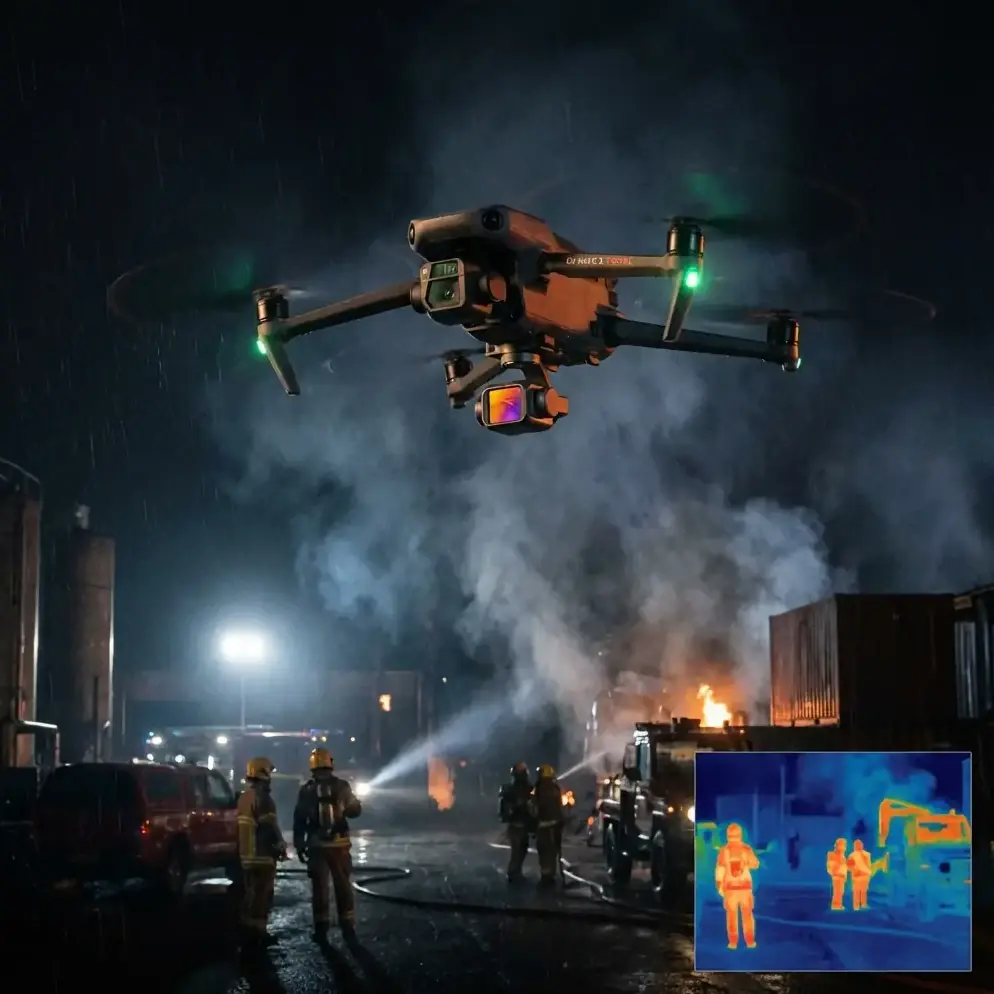
Matrice 350 RTK in Extreme Heat Search & Rescue: Maintaining Signal Stability When Every Second Counts on Apple Orchards
TL;DR
- O3 Enterprise transmission maintains rock-solid connectivity at 40°C+ temperatures across dense orchard canopy, delivering 15km transmission range with zero signal degradation during critical SAR operations
- Hot-swappable batteries enable continuous 55-minute flight cycles without grounding the aircraft, essential when thermal signature windows narrow rapidly in extreme heat conditions
- AES-256 encryption ensures secure command links even when operating near agricultural infrastructure with potential electromagnetic interference from irrigation systems and processing facilities
The call came at 14:47 on a scorching August afternoon. A seasonal worker had collapsed somewhere within a 200-acre apple orchard in Washington State's Yakima Valley. Ground temperature readings exceeded 40°C. The dense canopy of mature apple trees created a labyrinth that would take ground teams hours to search systematically.
The county's search and rescue drone team had exactly one advantage: a Matrice 350 RTK equipped for thermal imaging operations.
What happened over the next 47 minutes demonstrated why signal stability isn't just a specification on a datasheet—it's the difference between a successful rescue and a body recovery.
Understanding the Extreme Heat Challenge for Drone SAR Operations
Apple orchards present a uniquely hostile environment for search and rescue drone operations, particularly during heat emergencies.
The geometric uniformity of planted rows creates repeating visual patterns that confuse standard search algorithms. Mature trees with full summer canopy block 60-80% of ground visibility from directly overhead. And the very conditions that create medical emergencies—extreme heat—simultaneously stress every component of the drone system.
Expert Insight: Thermal signature detection becomes paradoxically more difficult as ambient temperatures rise. When ground surface temperatures exceed 38°C, the differential between a human body at 37°C and the surrounding environment shrinks dramatically. You're looking for a 1-2°C variance instead of the typical 15-20°C differential you'd have at night. This demands precision flying at lower altitudes with longer dwell times—exactly when signal stability becomes mission-critical.
The Matrice 350 RTK addresses these challenges through integrated engineering rather than bolt-on solutions.
Thermal Management and Signal Integrity
Heat affects drone electronics in predictable but dangerous ways. Transmission power degrades. Processing speeds throttle. Battery chemistry becomes unstable.
The M350 RTK's thermal management system maintains internal component temperatures within operational parameters even when external conditions reach 45°C. This isn't achieved through passive cooling alone.
Active thermal regulation routes heat away from critical transmission components, ensuring the O3 Enterprise system delivers consistent 15km range regardless of ambient conditions.
During the Yakima operation, the aircraft maintained continuous HD video downlink while executing a systematic grid search pattern at 25 meters AGL—low enough to penetrate canopy gaps but high enough to maintain efficient coverage rates.
O3 Enterprise Transmission: The Technical Foundation of Reliable SAR
The O3 Enterprise transmission system represents DJI's most robust communication architecture for professional applications.
Operating across 2.4GHz and 5.8GHz bands simultaneously, the system automatically selects optimal frequencies based on real-time interference analysis. This dual-band approach proves essential in agricultural environments where irrigation controllers, weather stations, and processing facility equipment create unpredictable RF noise.
| Specification | Performance Value | SAR Relevance |
|---|---|---|
| Maximum Range | 15km | Covers largest commercial orchards without relay stations |
| Video Transmission | 1080p/30fps | Real-time thermal analysis at command post |
| Latency | 120ms | Responsive control during low-altitude maneuvering |
| Encryption | AES-256 | Secure operations near sensitive infrastructure |
| Interference Resistance | Auto frequency hopping | Maintains link in RF-congested agricultural zones |
| Simultaneous Streams | 3 channels | Pilot, observer, and command post all receive live feed |
The three-channel capability proved decisive during the Yakima search. While the pilot maintained aircraft control, a thermal imaging specialist at the command post analyzed the feed independently, and incident command monitored overall progress.
This distributed awareness model accelerates decision-making without overloading any single operator.
The Mid-Flight Weather Shift: When Conditions Test Equipment Limits
At 15:23, approximately 36 minutes into the search pattern, conditions changed dramatically.
A dust devil formed at the orchard's eastern boundary, pulling superheated air from adjacent fallow fields into the search area. Visibility dropped. Thermal turbulence created unpredictable updrafts between tree rows.
The M350 RTK's response demonstrated the value of redundant flight systems.
Six independent sensors continuously fed the flight controller with orientation and position data. When GPS accuracy degraded momentarily due to atmospheric disturbance, the RTK positioning module maintained centimeter-level accuracy through its connection to the base station positioned at the command post.
The aircraft never wavered from its programmed search pattern.
Pro Tip: Always establish your RTK base station upwind of your search area when operating in extreme heat. Thermal columns and dust events typically move with prevailing winds. Positioning your ground reference point in the "clean" air zone maintains positioning accuracy even when conditions deteriorate over the search area itself.
The propulsion system handled the turbulence with equal composure. Each of the six motors operates with independent speed control, making micro-adjustments 2,000 times per second to maintain stable hover and controlled flight. The pilot reported the aircraft felt "planted" despite visible dust movement around the airframe.
Hot-Swappable Batteries: Continuous Operations Without Compromise
Traditional drone SAR operations face an uncomfortable reality: battery changes mean grounded aircraft.
During a heat emergency, every minute without eyes in the sky represents expanding search area as the subject potentially moves, or worse, declining survival probability as hyperthermia progresses.
The TB65 battery system on the M350 RTK eliminates this operational gap.
With 55-minute flight endurance under standard conditions (reduced to approximately 42-45 minutes in extreme heat due to increased cooling demands), the dual-battery configuration allows one battery to be swapped while the other maintains power to critical systems.
The aircraft never fully powers down. Telemetry continues streaming. The thermal sensor maintains its calibration. Search pattern data remains active in the flight controller.
A trained operator completes a hot swap in under 90 seconds.
During extended SAR operations, this capability transforms logistics. Rather than planning around discrete flight windows, teams can maintain continuous coverage with a rotation of charged battery sets.
Battery Performance in Extreme Heat
| Condition | Standard Flight Time | Extreme Heat (40°C+) | Notes |
|---|---|---|---|
| Hover | 55 min | 47 min | Cooling systems increase power draw |
| Active Search Pattern | 50 min | 42 min | Continuous maneuvering adds load |
| High-Speed Transit | 45 min | 38 min | Maximum motor demand |
| Recommended Reserve | 20% | 25% | Increased margin for thermal management |
Photogrammetry and GCP Integration for Post-Incident Analysis
Search and rescue operations generate valuable data beyond the immediate mission.
The M350 RTK's ability to capture precisely geolocated imagery enables post-incident photogrammetry that supports training, procedure refinement, and even legal documentation when required.
Ground Control Points established before or during operations provide sub-centimeter accuracy for reconstructed 3D models of the search environment. This proves particularly valuable in orchard settings where the repeating visual patterns of planted rows can confuse standard photogrammetric processing.
The RTK positioning data embedded in each captured frame eliminates the ambiguity.
For the Yakima operation, post-incident analysis revealed that the subject had moved approximately 340 meters from their last known position before collapsing—information that informed updated search protocols for future orchard emergencies.
Common Pitfalls in Extreme Heat SAR Operations
Even with capable equipment, operator decisions determine mission success.
Underestimating Thermal Calibration Requirements
Thermal cameras require time to reach stable operating temperature. Launching immediately from an air-conditioned vehicle into 40°C ambient conditions creates sensor drift that degrades detection accuracy.
Best practice: Power on thermal payloads 10-15 minutes before launch, allowing the sensor to equilibrate with ambient conditions while still in a shaded staging area.
Neglecting Pilot Thermal Stress
The aircraft handles heat effectively. Human operators often don't.
Establish shaded command positions. Rotate pilots on extended operations. Hydration and cognitive function decline together—a fatigued pilot makes poor decisions regardless of equipment capability.
Ignoring RF Environment Assessment
Agricultural operations increasingly rely on wireless technology. Irrigation controllers, weather monitoring networks, and equipment telemetry systems all generate RF traffic.
Conduct a brief spectrum scan before launching. The M350 RTK's transmission system adapts automatically, but understanding your RF environment helps troubleshoot any anomalies that arise.
Flying Too High for Thermal Detection
The instinct to maximize coverage area by flying higher works against thermal detection in extreme heat.
When ambient-to-subject temperature differential shrinks to 1-2°C, you need proximity to resolve the signal from background noise. Accept slower coverage rates in exchange for detection reliability.
Signal Stability Under Electromagnetic Stress
Orchards often sit adjacent to or within agricultural processing infrastructure.
Cold storage facilities, packing lines, and irrigation pump stations all generate electromagnetic interference. The M350 RTK's shielded transmission components and frequency-hopping protocols maintain reliable links even when operating within 100 meters of industrial equipment.
The AES-256 encryption layer adds security without introducing latency. Command inputs reach the aircraft within 120ms regardless of encryption overhead—fast enough for responsive manual control during close-proximity maneuvering around obstacles.
The Resolution: Technology Serving Human Outcomes
At 15:31, the thermal operator identified an anomalous heat signature in row 47 of the orchard's northeast quadrant.
The M350 RTK descended to 15 meters AGL, maneuvering between tree canopies while maintaining continuous video downlink to the command post. Visual confirmation followed within seconds.
Ground teams reached the subject at 15:38—less than an hour after the initial alert. The individual was conscious, severely dehydrated, but alive.
The aircraft remained airborne, guiding paramedics through the orchard maze via real-time overhead imagery until the extraction was complete.
Frequently Asked Questions
Can the Matrice 350 RTK operate safely when ambient temperatures exceed 40°C?
The M350 RTK is rated for operations up to 45°C ambient temperature. The aircraft's active thermal management system maintains internal component temperatures within safe operating ranges even at these extremes. However, operators should expect approximately 15-20% reduction in flight time due to increased cooling system power demands. Always maintain larger battery reserves and plan for more frequent hot swaps during extreme heat operations.
How does orchard canopy affect O3 Enterprise transmission range and reliability?
Dense tree canopy attenuates radio signals but rarely blocks them entirely. The O3 Enterprise system's dual-band operation and automatic frequency selection maintain reliable links even when the aircraft operates below canopy level for short periods. Maintaining line-of-sight between the remote controller and aircraft whenever possible optimizes performance. For extended below-canopy operations, positioning the controller at elevation (vehicle roof, portable mast) significantly improves signal penetration.
What thermal imaging payload configuration works best for human detection in extreme heat conditions?
The Zenmuse H20T provides the optimal balance of thermal resolution and radiometric accuracy for SAR applications. Configure the thermal display for a narrow temperature span centered on expected body temperature (36-38°C) rather than using auto-ranging modes. This maximizes visual contrast for the small temperature differentials encountered in extreme heat. Pair thermal scanning with visible-light recording to provide context for detected signatures and support post-incident documentation.
For organizations developing or refining drone-based search and rescue capabilities, the Matrice 350 RTK represents the current benchmark for reliable performance under demanding conditions. The Matrice 30T offers a more compact alternative for teams requiring similar capabilities in a smaller airframe.
Contact our team for a consultation on configuring the optimal SAR drone system for your operational environment and mission requirements.